Report 01 · Data Study
The State of US Valet & Parking 2026
It is profitable, recession-quiet, and almost invisible: a $9.5 billion business run by 137,880 people who park America's cars by hand. Now it faces the biggest disruption in its history, and the federal data already shows the ground moving.
On a Saturday night outside a downtown hotel, a valet in a black vest is running. Not jogging. Running, from the porte-cochère to a packed garage and back, keys jangling, because a line of SUVs has formed and the couple at the front has a dinner reservation in four minutes. They will do this perhaps eighty times before midnight. Eighty cars fetched at a sprint, eighty doors held, eighty folded bills palmed without counting. Somewhere in that exchange sits one of the last corners of the American economy where service still means a person standing in front of you.
There are 137,880 of them, and the federal government can tell you almost everything about the work except the part that makes it bearable. It knows they earn a median of $16.90 an hour, or $35,150 a year, and that eight in ten of them make between $13.00 and $21.42. 1 It knows there are 12,189 parking businesses in the country, and that they took in roughly $9.5 billion last year. 2 What it cannot see is the cash in their pockets, or the fact that the whole trade they work in is being bought, automated, and, in ten American cities right now, driven around by no one at all.
Industry at a glance
$4.0 billion
the federal payroll covering America's 137,880 parking attendants in 2025.
- Median hourly wage
- $16.90
- Annual median
- $35,150
- Parking businesses
- 12,189
- P10 to P90 wage band
- $13.00 to $21.42
Source: BLS Occupational Employment and Wage Statistics, May 2025; US Census County Business Patterns, 2023.
The best business you've never thought about
Parking does not look like a frontier. It looks like a concrete deck you forget the moment you leave it. Step back, though, and the economics are unusually friendly. Demand is structural, because cars have to go somewhere, and it barely flinches in a downturn. People keep parking even when they stop spending. The real estate often appreciates underneath the operator. And the barrier to running a single lot is low enough that a motivated person with a corner of asphalt and a few employees can open one.
Those 12,189 businesses are overwhelmingly small and local, a fragmented trade with no dominant brand, where the average shop runs a handful of people rather than a corporate roster. For an operator, the fragmentation is the opening. It is the precondition for a roll-up, the reason a single well-run regional player can assemble dozens of lots before the public ever notices the logo change on the ticket stub.
It is also a forgiving place to start. American small businesses fail hard as a rule, with about one in five new establishments closing inside a year and roughly half gone within five. 3 A parking lot with a contract and a fixed location is stickier than most of them, and certainly stickier than a restaurant. None of that makes it easy. But it explains how a sleepy, unglamorous business has spent a century absorbing every recession and throwing off cash.
Why the same job pays double
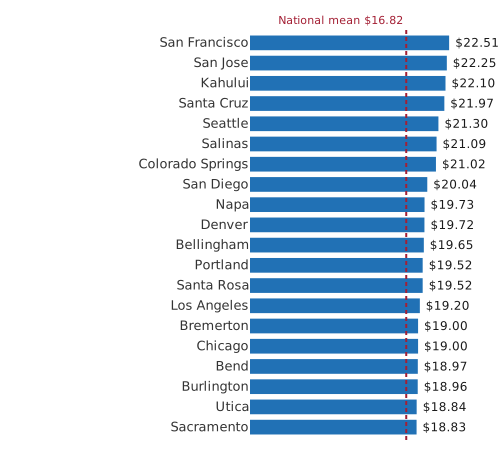
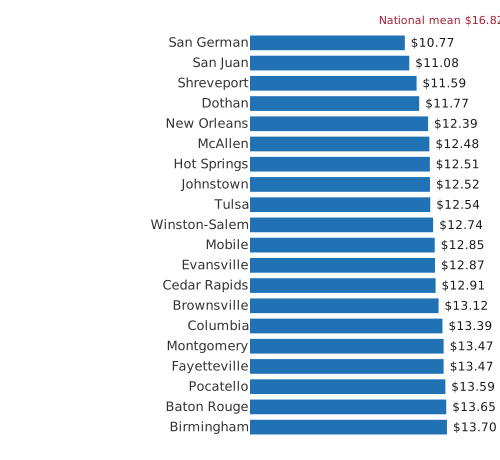
The same job, under the same federal labor laws, nearly doubles in pay depending on which city you stand in. In San Francisco the average parking attendant makes $22.51 an hour. In Shreveport, Louisiana, it is $11.59. In Puerto Rico's San Germán, the true national floor, it is $10.77. 1 A worker can move a thousand miles across the mainland and watch the value of identical work fall by half.
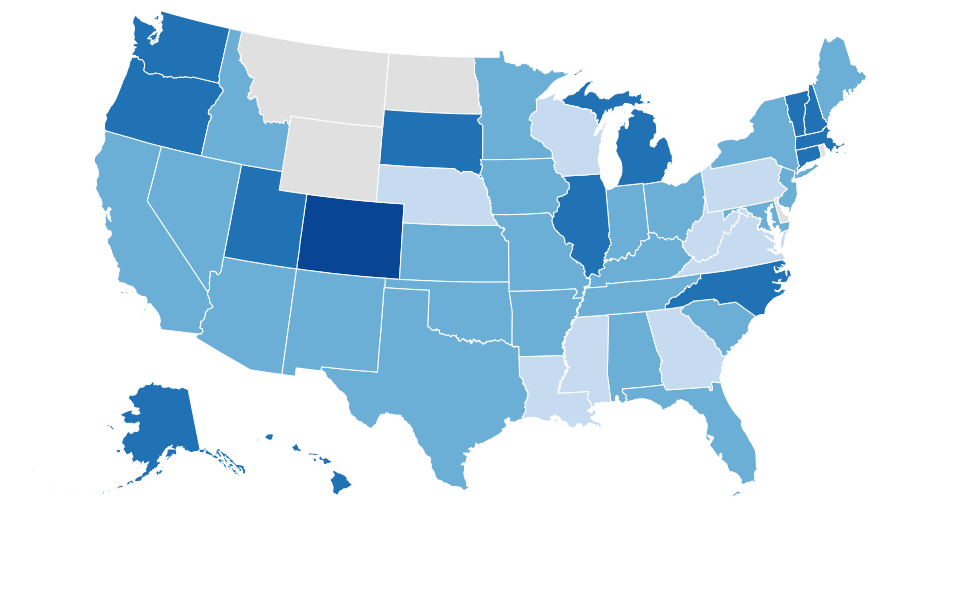
Median hourly wage for parking attendants (SOC 53-6021), all 50 states.
Source: BLS Occupational Employment and Wage Statistics, May 2025.
Three forces stack up to produce that gap. The first is the local minimum wage. The floor in a high-cost coastal city can sit at nearly double the federal one, and a job paid near the floor rises with it. The second is what a city's wealth supports. The dense thicket of hotels, fine-dining rooms, hospitals, and event venues that actually demand valets clusters where there is money to spend, and that demand bids up pay. The third is tipping culture, which the federal number cannot see at all. A wage map like this one usually gets read as trivia. It reads better as a picture of how American pay gets set: by policy, by density, and by wealth at the same time.
That $22.51 carries an awkward asterisk. Adjusted for what it costs to live where it is earned, the highest wage on paper stops being the highest wage in practice. By the federal government's own regional price measures, a dollar in the Bay Area buys far less than a dollar in Denver or Salt Lake City. Once rent enters the math, San Francisco's chart-topping pay compresses toward the mountain-metro wages that look lower in the table, and sometimes drops below them. 4 Measured by what the paycheck buys, a mid-cost mountain metro can beat San Francisco outright.
Metros, ranked by pay
Top 20 metros
Bottom 20 metros
Top 10 metros
| Metro | Hourly mean |
|---|---|
| San Francisco, CA | $22.51 |
| San Jose, CA | $22.25 |
| Kahului, HI | $22.10 |
| Santa Cruz, CA | $21.97 |
| Seattle, WA | $21.30 |
| Salinas, CA | $21.09 |
| Colorado Springs, CO | $21.02 |
| San Diego, CA | $20.04 |
| Napa, CA | $19.73 |
| Denver, CO | $19.72 |
Show ranks 11 through 20
| Metro | Hourly mean |
|---|---|
| Bellingham, WA | $19.65 |
| Portland, OR | $19.52 |
| Santa Rosa, CA | $19.52 |
| Los Angeles, CA | $19.20 |
| Bremerton, WA | $19.00 |
| Chicago, IL | $19.00 |
| Bend, OR | $18.97 |
| Burlington, VT | $18.96 |
| Utica, NY | $18.84 |
| Sacramento, CA | $18.83 |
Bottom 10 metros
| Metro | Hourly mean |
|---|---|
| San German, PR | $10.77 |
| San Juan, PR | $11.08 |
| Shreveport, LA | $11.59 |
| Dothan, AL | $11.77 |
| New Orleans, LA | $12.39 |
| McAllen, TX | $12.48 |
| Hot Springs, AR | $12.51 |
| Johnstown, PA | $12.52 |
| Tulsa, OK | $12.54 |
| Winston-Salem, NC | $12.74 |
Show ranks 11 through 20
| Metro | Hourly mean |
|---|---|
| Mobile, AL | $12.85 |
| Evansville, IN | $12.87 |
| Cedar Rapids, IA | $12.91 |
| Brownsville, TX | $13.12 |
| Columbia, SC | $13.39 |
| Fayetteville, NC | $13.47 |
| Montgomery, AL | $13.47 |
| Pocatello, ID | $13.59 |
| Baton Rouge, LA | $13.65 |
| Birmingham, AL | $13.70 |
Then there is the number nobody reports, because the government declines to count it. The federal wage leaves out gratuities entirely, and in valet the tip is much of the job. The going rate runs $3 to $5 a car, more at hotels and for careful handling, almost always in cash. 5 At a busy venue that can rival the base wage and occasionally beat it. So the official $16.90 describes a worker who, on a good Saturday, takes home a good deal more, and whose real income stays invisible to the statisticians, the tax base, and any machine built to replace them. The honest move is to treat the tip as a wide range rather than a fixed figure. The dishonest move is to treat it as zero, which is exactly what the federal data does.
Hourly mean wage by metropolitan area. Source: BLS OEWS May 2025.
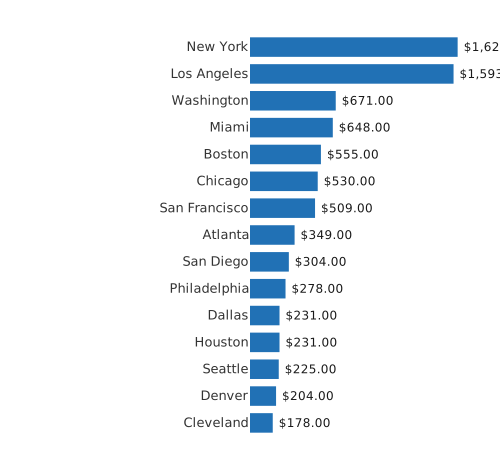
America's parking capitals
| Metro | Establishments |
|---|---|
| New York, NY | 1,625 |
| Los Angeles, CA | 1,593 |
| Washington, DC | 671 |
| Miami, FL | 648 |
| Boston, MA | 555 |
| Chicago, IL | 530 |
| San Francisco, CA | 509 |
| Atlanta, GA | 349 |
| San Diego, CA | 304 |
| Philadelphia, PA | 278 |
| Dallas, TX | 231 |
| Houston, TX | 231 |
| Seattle, WA | 225 |
| Denver, CO | 204 |
| Cleveland, OH | 178 |
Show all metros
| Metro | Establishments |
|---|---|
| Minneapolis, MN | 175 |
| Baltimore, MD | 160 |
| Indianapolis, IN | 133 |
| Orlando, FL | 131 |
| Columbus, OH | 122 |
| St. Louis, MO | 119 |
| Honolulu, HI | 112 |
| Hartford, CT | 94 |
| Phoenix, AZ | 94 |
| Tampa, FL | 94 |
| Portland, OR | 93 |
| San Antonio, TX | 92 |
| Cincinnati, OH | 88 |
| Austin, TX | 86 |
| Nashville, TN | 86 |
| Pittsburgh, PA | 86 |
| New Orleans, LA | 84 |
| Providence, RI | 79 |
| Detroit, MI | 75 |
| Riverside, CA | 73 |
| Kansas City, MO | 67 |
| Sacramento, CA | 67 |
| San Jose, CA | 67 |
| Charlotte, NC | 65 |
| New Haven, CT | 65 |
| Milwaukee, WI | 61 |
| Bridgeport, CT | 59 |
| Tulsa, OK | 53 |
| Las Vegas, NV | 47 |
| Jacksonville, FL | 34 |
| Oklahoma City, OK | 34 |
| Raleigh, NC | 32 |
| Memphis, TN | 31 |
| Salt Lake City, UT | 27 |
| Worcester, MA | 27 |
| Stockton, CA | 26 |
| Akron, OH | 24 |
| Syracuse, NY | 23 |
| Birmingham, AL | 22 |
| Richmond, VA | 21 |
| Albany, NY | 20 |
| Tucson, AZ | 20 |
| Virginia Beach, VA | 19 |
| Cape Coral, FL | 18 |
| Buffalo, NY | 17 |
| North Port, FL | 17 |
| Lexington, KY | 16 |
| Mobile, AL | 16 |
| Portland, ME | 16 |
| Knoxville, TN | 15 |
| Louisville, KY | 14 |
| Santa Barbara, CA | 14 |
| Charleston, WV | 13 |
| Chattanooga, TN | 13 |
| Colorado Springs, CO | 13 |
| Dayton, OH | 13 |
| Deltona, FL | 13 |
| Kahului, HI | 13 |
| Lincoln, NE | 13 |
| Golden Gate, FL | 13 |
| Shreveport, LA | 13 |
| Des Moines, IA | 12 |
| Grand Rapids, MI | 12 |
| Oxnard, CA | 12 |
| Pensacola, FL | 12 |
| Kalamazoo, MI | 11 |
| Toledo, OH | 11 |
| Durham, NC | 10 |
| Albuquerque, NM | 9 |
| Atlantic City, NJ | 9 |
| El Paso, TX | 9 |
| Little Rock, AR | 9 |
| Nashua, NH | 9 |
| Omaha, NE | 9 |
| Winston-Salem, NC | 9 |
| Youngstown, OH | 9 |
| Baton Rouge, LA | 8 |
| Fresno, CA | 8 |
| Gulfport, MS | 8 |
| Norwich, CT | 8 |
| Palm Bay, FL | 8 |
| Salinas, CA | 8 |
| Scranton, PA | 8 |
| Sevierville, TN | 8 |
| Spokane, WA | 8 |
| Canton, OH | 7 |
| Charleston, SC | 7 |
| Charlottesville, VA | 7 |
| Fort Wayne, IN | 7 |
| Lancaster, PA | 7 |
| Rochester, NY | 7 |
| Savannah, GA | 7 |
| Springfield, MA | 7 |
| Waterbury, CT | 7 |
| Wilmington, NC | 7 |
| Asheville, NC | 6 |
| Boulder, CO | 6 |
| Columbia, SC | 6 |
| El Centro, CA | 6 |
| Greensboro, NC | 6 |
| Jackson, MS | 6 |
| Madison, WI | 6 |
| Myrtle Beach, SC | 6 |
| Allentown, PA | 5 |
| Anchorage, AK | 5 |
| Ann Arbor, MI | 5 |
| Athens, GA | 5 |
| Battle Creek, MI | 5 |
| Burlington, VT | 5 |
| Crestview, FL | 5 |
| Duluth, MN | 5 |
| Harrisburg, PA | 5 |
| Port St. Lucie, FL | 5 |
| Northampton, MA | 4 |
| South Yarmouth, MA | 4 |
| Binghamton, NY | 4 |
| Boise, ID | 4 |
| College Station, TX | 4 |
| Corpus Christi, TX | 4 |
| Edwards, CO | 4 |
| Flint, MI | 4 |
| Fort Smith, AR | 4 |
| McAllen, TX | 4 |
| Montgomery, AL | 4 |
| Reno, NV | 4 |
| Rockford, IL | 4 |
| Santa Rosa, CA | 4 |
| Sioux City, IA | 4 |
| Tallahassee, FL | 4 |
| Trenton, NJ | 4 |
| Appleton, WI | 3 |
| Augusta, GA | 3 |
| Bakersfield, CA | 3 |
| Davenport, IA | 3 |
| Elmira, NY | 3 |
| Fairbanks, AK | 3 |
| Fargo, ND | 3 |
| Fayetteville, AR | 3 |
| Green Bay, WI | 3 |
| Greenville, SC | 3 |
| Janesville, WI | 3 |
| Killeen, TX | 3 |
| Poughkeepsie, NY | 3 |
| La Crosse, WI | 3 |
| Lafayette, IN | 3 |
| Lansing, MI | 3 |
| Napa, CA | 3 |
| Panama City, FL | 3 |
| Provo, UT | 3 |
| Reading, PA | 3 |
| Spartanburg, SC | 3 |
| Springfield, IL | 3 |
| Vallejo, CA | 3 |
Parking establishment count by metropolitan area (NAICS 812930). Source: US Census County Business Patterns, 2023.
Two jobs wearing the same uniform
Look closely and "parking attendant" turns out to cover two different jobs filed under one government code. The first is a commodity task: sit in a booth, raise a gate, take a card, watch a self-park deck where the driver does the walking. The second is a service: take the keys, hold the door, remember the regular, sprint for the car, earn the tip. One is a transaction. The other is hospitality. The gap between them is about to decide who still has a career in ten years and who does not.
For now the ceiling on both is low. The wage band shows most attendants topping out close to where they start. The ladder inside the job is short. The rungs do exist. Shift lead, then site supervisor, then the operations and facilities managers who run whole portfolios of lots, a management tier whose pay climbs into six figures within the broader transportation-and-logistics category it belongs to. 6 But the climb from the curb to that office is long and narrow. The seasonal shape of the work does not help. Demand swings hard, peaking in December at roughly 2.3 times the January low as holiday parties and the wedding-and-gala circuit land at once. A job that triples in intensity by season is a job that leans on part-time and seasonal labor, which stacks unstable hours on top of low pay.
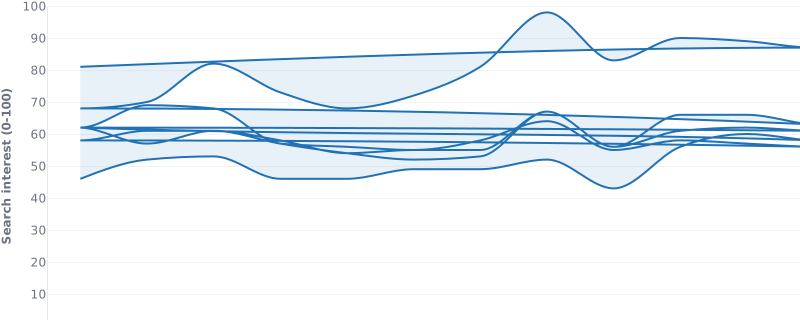
Relative search interest for 'valet parking' in the US, indexed to peak month = 100. Source: Google Trends, 2020 to 2025 average.
The cliff
Automation is already inside this business, and it is arriving from two directions at once.
The first direction is the back office, and it moved while almost no one was watching. In May 2024 an AI startup called Metropolis took the largest parking operator in North America, SP+, private for about $1.5 billion, the biggest venture-backed acquisition of that year. Metropolis sells computer-vision parking: you drive in, cameras read your plate, and you drive out with no ticket, no booth, and no cashier. The combined company now runs more than 4,000 locations and processes around $4 billion in payments a year, and by 2026 it was valued at roughly $5 billion and described as an AI infrastructure business that happens to own the lots. 7 The booth attendant, the commodity half of the job, is being engineered out of existence by people who think of parking as a data problem.
The second direction is the obvious one, and it is further along than most people realize. Waymo now gives roughly 500,000 paid driverless rides every week across ten US cities, up from 50,000 a week just two years ago, with a fleet of more than 3,000 robotaxis and plans to enter twenty more cities in 2026. 8 A car that drives itself does not need a person to park it. A robotaxi that never stops circulating does not need to be parked at all. Push that curve out two decades and the demand side of this whole industry starts to look different.
Among Waymo's ten live cities are San Francisco and Los Angeles, with Denver and San Diego next on the map. Set that against the top of the wage table and the overlap is hard to miss. The country's two biggest high-wage parking markets already have driverless fleets on the street, and two more near the top are next in line. The timing follows the money: automation goes where the revenue is densest, which puts the high-wage end first.
The ledge below the cliff
The cliff has a ledge, though, and the ledge is exactly the part of the job the federal data cannot measure.
Automation eats the commodity half cleanly: the gate, the booth, the self-park deck, the driving itself. The hospitality half is far harder for it. A wedding pays for one thing above all, the absence of friction on the most stressful day of someone's life. A five-star hotel sells a feeling that begins the instant a hand opens the door. A fine-dining room knows the valet is the first and last impression of the evening. That is a person and a handshake, and it does not download. The high-touch corner of valet, the corner that earns the tip, is also the corner an algorithm is worst at replacing.
The transition will also be slower and messier than the headlines suggest. Autonomy arrives city by city and neighborhood by neighborhood, never nationwide on a single morning, and the regulatory and insurance fights alone will run for years. The cars themselves still have to be cleaned, charged, staged, and stored somewhere, which is new work that has no tidy government occupation code yet. A fleet depot is, in effect, a parking lot that never closes. Demand for human valet at the luxury end may even climb as it becomes a deliberate marker of service in a driverless world. The floor here splits down the middle.
So what happens now
The likeliest outcome is divergence. The single job filed under one federal code is pulling apart into two trajectories. The commodity tier, the booths and gates and self-park decks, gets automated from the back office outward, and the people in it are the most exposed workers in this report. The hospitality tier, the hotels and galas and dining rooms, grows more valuable, and the operators and workers concentrated there are the most insulated. The wage chasm earlier in this piece is the first visible sign of that split. The high-touch, high-wage, high-tip end and the commodity, low-wage end were always different businesses. Automation will simply force everyone to admit it.
For anyone weighing whether to enter this trade, to work in it or to build one, the data and the analysis point the same way. The defensible end is the human one. The lots worth owning are the ones automation makes more efficient rather than obsolete. And the question that opened this report, whether anyone will still park cars by hand in twenty years, has an answer that is starting to show up in the numbers. Yes, but fewer of them, paid better, doing the half of the job that was never really about the car.
We cannot tell you the exact shape of that curve yet. No one can. What we can do is more useful than a prediction. Every year we will run this report again, against the same federal data, and show you which way the line has actually moved. The baseline is on this page. Come back and watch it bend.
Use this data
Every wage and establishment figure on this page is yours. All 50 states. 210 metropolitan areas. One CSV. Public-domain license.
The directory itself is open too. Every live operator as CSV, one JSON document per city, and a feed index that lists them all. Same fields as the public pages, rebuilt on every deploy, CC BY 4.0.
What this study does not measure
The federal data on this page captures the labor side of valet and parking: how many people are employed, what they earn, where they work. It does not capture pricing.
For day-rates and hourly garage rates, see the Parkopedia and SpotHero indexes. For wedding valet, see The Knot 's Real Weddings Study. Independent observation across markets: event valet runs $15 to $75 per vehicle depending on city, duration, and staffing ratio. Treat that as a range, not a benchmark.
Sources
- Wages, employment, and percentile bands for Parking Attendants (SOC 53-6021): BLS Occupational Employment and Wage Statistics, May 2025. ↩
- Establishment count and payroll for Parking Lots and Garages (NAICS 812930): US Census County Business Patterns, 2023; industry revenue (~$9.5B across ~12,000 establishments) via First Research, Parking Lots & Garages Industry Profile. ↩
- One-year and five-year business survival rates: BLS Business Employment Dynamics, Establishment Age and Survival. ↩
- Cost-of-living adjustment concept: BEA Regional Price Parities by state and metro area. ↩
- Valet tipping norms ($3–$5 per car, more at hotels): NerdWallet; Remitly. ↩
- Management tier pay, Transportation, Storage, and Distribution Managers (SOC 11-3071), median ~$102k: BLS Occupational Outlook Handbook. (Broad category; parking management is a subset.) ↩
- Metropolis take-private of SP+ (~$1.5B, closed May 2024; combined ~4,000 locations): Metropolis; TechCrunch; ~$5B valuation framing via Fortune, May 2026. ↩
- Waymo ridership and expansion (~500k paid rides/week, 10 cities, 3,000+ vehicles, 20+ new cities in 2026): TechCrunch; CNBC. ↩
How to cite
GetValetParking.com. The State of US Valet & Parking 2026. Published May 2026. https://getvaletparking.com/data/
Embed any chart with attribution. Chart URLs follow the pattern:
<img src="https://getvaletparking.com/charts/state-wages.svg" alt="US parking attendant median hourly wage by state, 2025" width="975" />
Available charts: state-wages, metro-top, metro-bottom, parking-capitals, seasonality.
Data last updated: May 2026. This report is refreshed annually.
Methodology and sources
SOC 53-6021 ("Parking Attendants") is the labor proxy. It covers all parking lot and garage attendants, a reliable measure that includes valet workers as the primary occupational category. It does not isolate valet-only workers from attendants who manage self-park facilities.
NAICS 812930 ("Parking Lots and Garages") is the business establishment proxy. It captures all commercial parking operations, broader than valet-only operators. The 12,189 establishment count reflects the full parking industry, not valet-exclusive businesses.
| Source | Coverage | Vintage |
|---|---|---|
| BLS OEWS | Wages, employment: national, 50 states, 210 metros | May 2025 |
| US Census CBP | Establishments, employees, payroll | 2023 |
| Google Trends | Relative search interest | 2020 to 2025 avg |